How Does QR Code Anti-Counterfeiting Work?
Learn the technical details behind QR code anti-counterfeiting: the verification process, security mechanisms, data analytics, and advantages over traditional labels.
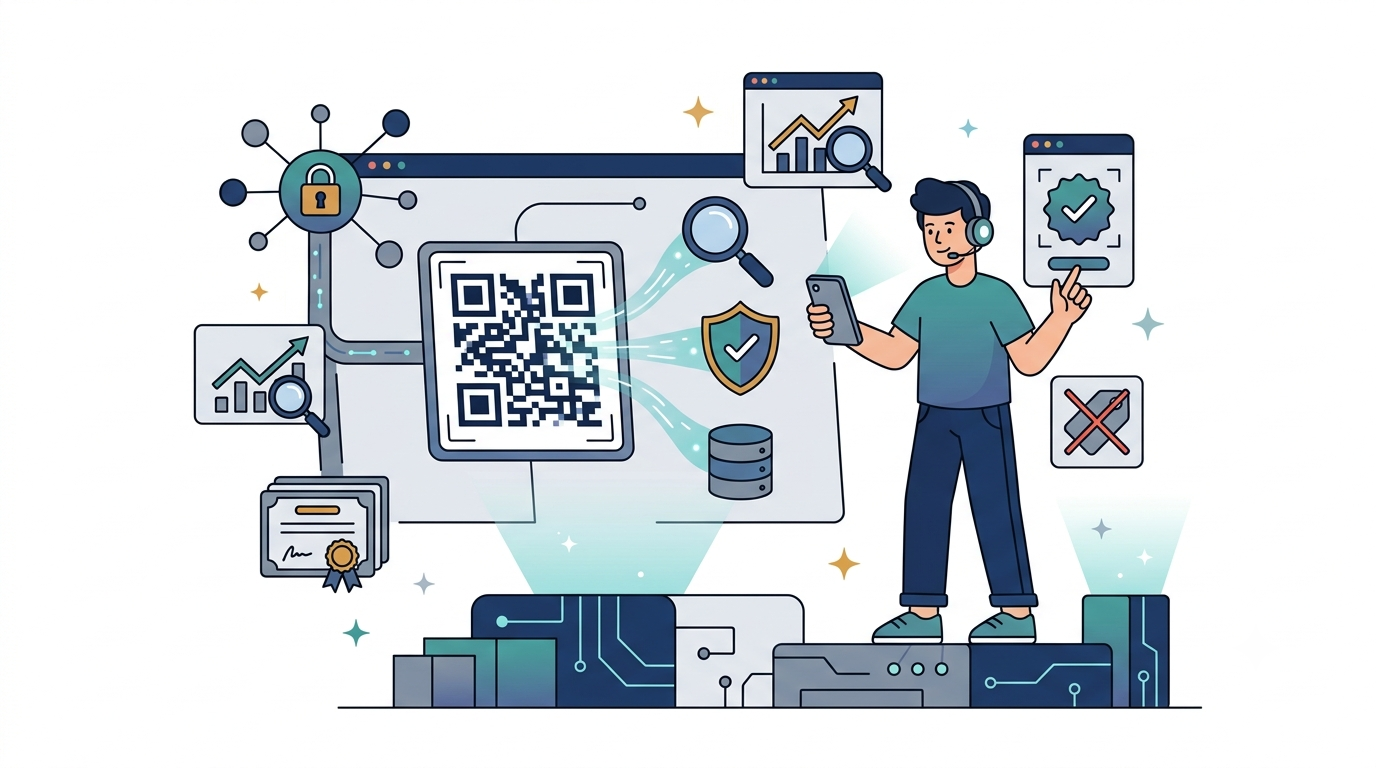
TL;DR: QR code anti-counterfeiting works by assigning each product a unique, encrypted QR code linked to a database, so a consumer scan can look the code up in real time and confirm authenticity in 1-2 seconds. The system layers encryption, scan limits, anomaly detection, and tamper-evident labels to prevent copying, reuse, and diversion — replacing slower SMS verification with richer, traceable data.
How Does QR Code Anti-Counterfeiting Work?
QR code anti-counterfeiting uses unique QR codes attached to each product to verify authenticity. Unlike standard QR codes that contain only static information, anti-counterfeit QR codes link to a database system, enabling real-time verification and tracking.
Detailed Verification Process
Step 1: Generate Unique QR Codes
Each product is assigned a unique QR code (UUID - Universally Unique Identifier). The generation process is fully automated:
- The system creates a non-duplicatable unique identifier
- The code is encrypted and embedded into the QR code
- The QR code is printed directly on labels, packaging, or product tags
- Code information is stored in the database along with product details (batch, manufacturing date, expiry date)
Step 2: Apply Labels to Products
QR code labels are applied to products at the factory or distribution warehouse:
- Labels printed on water-resistant, tear-resistant material
- Can be combined with holograms or UV ink for enhanced security
- Each label is valid only for a specific product
- Label placement is standardized for easy identification
Step 3: Consumer Scans the Code
When purchasing a product, consumers perform verification:
- Open phone camera or QR scanning app
- Point camera at the QR code on the product
- The system automatically detects and redirects to the verification page
- View verification results within 1-2 seconds
Step 4: System Processes Verification
When a QR code is scanned, the system follows this process:
- Decode: Read the identifier from the QR code
- Lookup: Search for the code in the database
- Verify: Validate the code’s authenticity
- Return results: Display verification status
Step 5: Display Results
The system returns one of these statuses:
- Authentic: Code is valid, first-time verification
- Previously verified: Code has been scanned before, shows count and scan locations
- Invalid: Code does not exist in the system, possible counterfeit
- Expired: Code has exceeded its validity period
Security Mechanisms
Data Encryption
Anti-counterfeit QR codes use encryption to protect data:
- Identifiers are encrypted before being embedded in the QR code
- Data transmitted via HTTPS
- Cannot generate fake codes through guessing or copying
Scan Limits
Each QR code has verification limits:
- First scan: Displays full authentication information
- Subsequent scans: Shows “previously verified” but records location and time
- If a code is scanned too many times from different locations, the system alerts
Anomaly Detection
The system analyzes scan data to detect counterfeits:
- Same code scanned from multiple cities: Label may have been copied
- Abnormal scan frequency: Code scanned thousands of times in a short period
- Scan location doesn’t match distribution area: Product may have been diverted
Tamper-Evident Labels
- Labels use destructible material (breaks when peeled)
- When the label is removed, the QR code is destroyed, preventing reuse
- Void material displays “VOID” text when peeled
Comparison with Traditional Labels
| Criteria | SMS Labels | QR Code Labels |
|---|---|---|
| Verification speed | 10-30 seconds | 1-2 seconds |
| Cost to consumer | SMS fee | Free |
| Information displayed | Text only | Rich media |
| Data collection | Limited | Comprehensive |
| Verification rate | Under 5% | 15-30% |
| Information updates | No | Yes, real-time |
| Experience | Send SMS, wait for reply | Scan and view instantly |
Benefits for Businesses
Detailed Consumer Data
Each scan provides valuable data:
- Geographic location of the scanner
- Scan time
- Device used
- Product information scanned
Reporting and Analytics
- Heat map of regions with high counterfeit activity
- Verification rate statistics by region and product
- Automatic alerts when anomalies are detected
- Consumer trends over time
Distribution Chain Management
- Track products from factory to retail
- Detect unauthorized product transfers between regions
- Verify products at each point in the supply chain
Conclusion
QR code anti-counterfeiting is a modern, fast, and effective verification solution. With multi-layer security, rich data collection, and optimal consumer experience, QR codes are replacing traditional methods. QRS provides a complete QR code anti-counterfeit platform with full security, reporting, and management features for businesses of all sizes.
Frequently Asked Questions
How can a consumer tell if a product is authentic?
The consumer opens a phone camera or QR scanning app, points it at the QR code on the product, and is redirected to a verification page that returns a result within 1-2 seconds. The status — Authentic, Previously verified, Invalid, or Expired — is determined by looking the encrypted identifier up in the brand’s database, not by reading the code itself.
What happens if the same QR code is scanned many times?
The first scan returns full authentication details, while subsequent scans are flagged as “previously verified” but still record time and location. If a single code is scanned from many different cities, at abnormal frequency, or outside its expected distribution area, the system raises an anomaly alert because the label may have been copied.
How do anti-counterfeit QR codes stop label reuse?
Labels are printed on tamper-evident material such as destructible or VOID film, so peeling the label off destroys the QR code and prevents it from being reapplied to a fake product. Combined with per-code encryption and database-backed verification, this removes the economic incentive to copy a label.
How does this compare to SMS-based verification?
QR verification completes in 1-2 seconds at no cost to the consumer and returns rich media, while SMS verification takes 10-30 seconds, costs an SMS fee, and returns text only. QR systems also collect comprehensive scan data — geography, time, device, and product — that SMS cannot, which is why reported verification rates rise from under 5% to 15-30%.
Sources
- Trends in Trade in Counterfeit and Pirated Goods (OECD/EUIPO) — the joint OECD and EU Intellectual Property Office study quantifying the scale of global counterfeiting that motivates database-backed verification.
- GS1 Digital Link standard — the global supply-chain standard for encoding GTINs, serial numbers, batch, and expiry data into web-resolvable 2D barcodes such as QR codes.
- ISO/IEC 18004 — QR Code bar code symbology specification — the international standard defining the QR Code symbology that anti-counterfeit labels rely on.
- ISO 12931 — Performance criteria for authentication solutions against counterfeiting of material goods — ISO framework laying out the performance criteria an authentication solution (including QR-based ones) should meet.
Found this helpful?
Explore more articles on this topic