Common Types of Anti-Counterfeit Labels
A comprehensive overview of the most common anti-counterfeit label types: hologram, QR code, SMS, NFC, RFID. Compare pros and cons to choose the right solution.
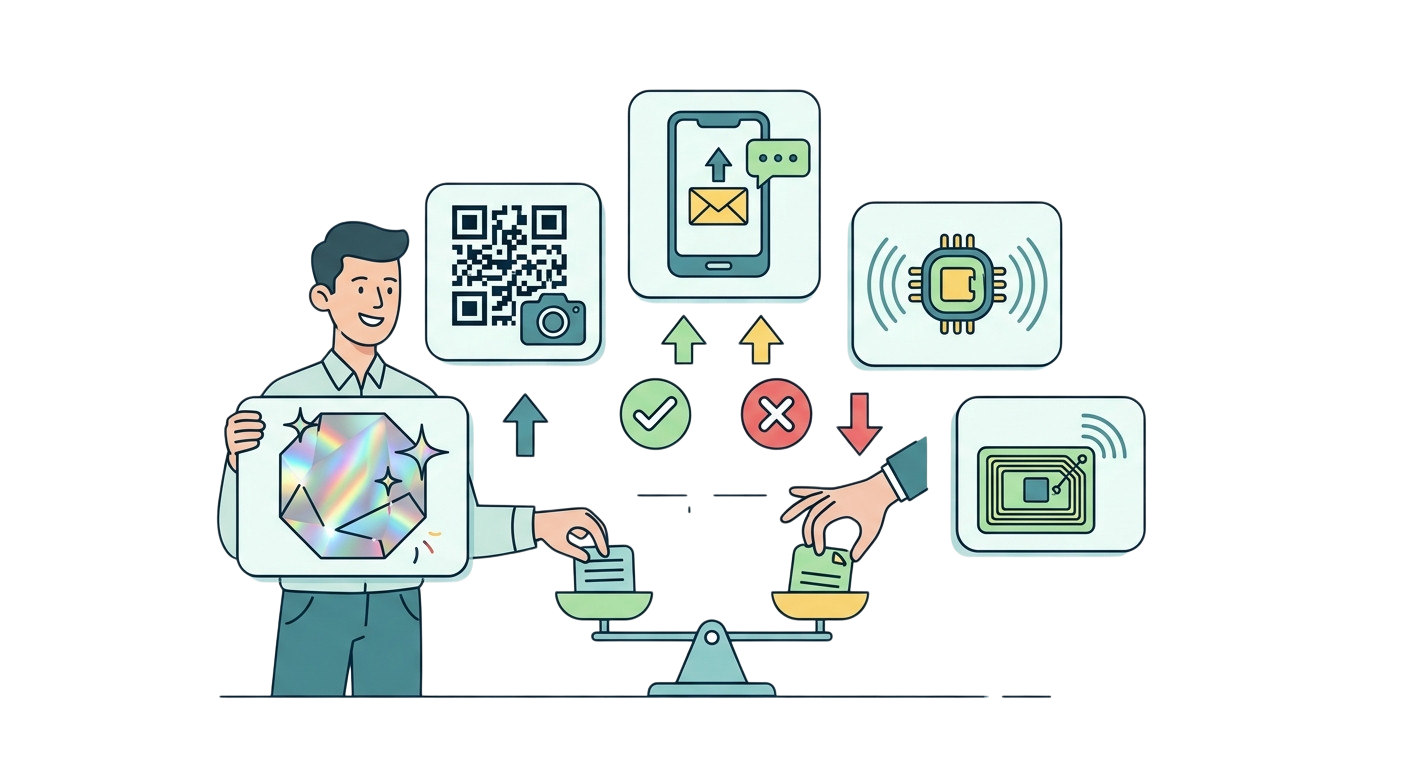
TL;DR: The most common anti-counterfeit label types are hologram, SMS, QR code, NFC, RFID, and multi-layer labels. QR code labels are the most popular choice because they combine low cost, fast verification, and consumer data collection, while multi-layer labels (such as hologram + QR code) offer the highest protection for products that need maximum security.
Common Types of Anti-Counterfeit Labels
The anti-counterfeit label market has evolved significantly, from simple printed labels to high-tech solutions. This article covers the most common types of anti-counterfeit labels, helping businesses understand each option to make the right choice.
1. Hologram Labels
How They Work
Hologram labels use optical technology to create 3D images on the label surface. The image changes when viewed from different angles, creating a visual effect that’s difficult to replicate.
Types
- 2D Hologram: Color-shifting image, most common type
- 2D/3D Hologram: Combines depth effect, harder to copy
- 3D Hologram: True 3D image, highest cost
- Dot-matrix hologram: Made from thousands of tiny pixels, contains hidden information
Pros and Cons
| Pros | Cons |
|---|---|
| Easy to spot visually | Hologram printing technology has been widely copied |
| Enhances product aesthetics | Consumers struggle to distinguish real from fake holograms |
| Reasonable cost for large volumes | No digital authentication capability |
| Multiple security levels | Cannot collect consumer data |
2. SMS Labels
How They Work
SMS labels print a unique code (typically 10-15 digits) under a scratch-off layer. Consumers scratch the label, send an SMS to a hotline, and receive authentication results via return message.
Usage Process
- Scratch the protective layer on the label
- Compose an SMS following the instructions (e.g., QRS 1234567890)
- Send to the hotline number
- Receive result: “Authentic product” or “Code previously verified”
Pros and Cons
| Pros | Cons |
|---|---|
| No internet required | SMS cost for consumers |
| Suitable for older demographics | Slow (waiting for return message) |
| Well-established in Vietnam | Limited data, no images |
| Simple deployment | Low verification rate (under 5%) |
3. QR Code Labels
How They Work
QR code labels print a unique QR code on each product. Consumers scan the code with their phone camera, and the system checks the database and displays results instantly.
Usage Process
- Open phone camera or QR scanning app
- Scan the QR code on the product
- The system automatically checks and displays results
- View additional product info: manufacturing date, batch number, usage instructions
Pros and Cons
| Pros | Cons |
|---|---|
| Fast verification (1-2 seconds) | Requires internet connection |
| Low label cost | Users need a smartphone |
| Collects consumer data | Requires a management platform |
| Rich media interaction | Depends on print quality |
| High verification rate (15-30%) |
4. NFC Labels
How They Work
NFC (Near Field Communication) labels contain a small NFC chip. Consumers simply tap their phone on the label to authenticate, without opening an app or camera.
Usage Process
- Bring phone near the NFC label (1-2 cm)
- Phone automatically detects and opens the verification page
- View authentication results and product information
Pros and Cons
| Pros | Cons |
|---|---|
| Optimal experience (tap to check) | Highest label cost (5-10x QR code) |
| High security, chips hard to clone | Not all phones support NFC |
| No printed code, high aesthetics | More complex deployment |
| Excellent copy protection | Best suited for high-value products |
5. RFID Labels
How They Work
RFID (Radio Frequency Identification) labels use radio waves to transmit data. Unlike NFC, RFID can be read from a distance and scan multiple labels simultaneously.
Main Applications
- Warehouse and supply chain management
- Bulk checking at stores and warehouses
- Detecting counterfeits in large shipments
- Tracking product flow from factory to retail
Pros and Cons
| Pros | Cons |
|---|---|
| Read multiple labels simultaneously | High deployment cost |
| Read from distance (several meters) | Requires specialized reading equipment |
| Integrated supply chain management | Not suitable for direct consumer verification |
| High security | Requires technical infrastructure |
6. Multi-Layer Labels
How They Work
Multi-layer labels combine multiple security features on a single label. The most common example is hologram + QR code, combining physical and digital security.
Common Combinations
- Hologram + QR Code: Visual identification + digital authentication
- QR Code + NFC: Two independent verification channels
- Hologram + SMS + QR Code: Three authentication methods
- QR Code + Invisible ink: Hidden second QR code under invisible ink
Comparison Overview
| Label Type | Cost/Label | Security | Experience | Data Collection | Best For |
|---|---|---|---|---|---|
| Hologram | Low | Medium | Low | No | Mass-market products |
| SMS | Low | Medium | Medium | Low | SMS-familiar markets |
| QR Code | Very Low | High | High | High | Diverse industries |
| NFC | High | Very High | Very High | High | Premium products |
| RFID | High | Very High | Low* | High | Supply chain management |
| Multi-layer | Medium | Very High | High | High | Maximum protection needed |
*For end consumers specifically
Conclusion
Each type of anti-counterfeit label has its own strengths and weaknesses. QR code labels are the most popular choice due to low cost, easy deployment, and consumer data collection capabilities. For businesses needing higher security, multi-layer labels (hologram + QR code) are the optimal choice. QRS specializes in QR code anti-counterfeit solutions with a complete management platform suitable for businesses of all sizes.
Frequently Asked Questions
Which anti-counterfeit label is best for mass-market products?
For mass-market products, QR code labels are usually the best fit because the cost per label is very low, verification is fast (around 1-2 seconds), and the system can collect consumer data. Hologram labels are also a low-cost option when the goal is only visual identification rather than digital authentication.
Why is the verification rate for SMS labels so low?
SMS labels typically see verification rates under 5% because the process requires consumers to scratch the label, compose a message, and wait for a reply. The extra steps, the SMS cost to the consumer, and the slow response time discourage most buyers from checking, even when the label is present.
When should a business choose NFC over QR code labels?
NFC labels make sense for premium and high-value products where the optimal consumer experience matters most. A simple tap authenticates the product without opening an app or camera, and the chip is hard to clone. The trade-off is cost: NFC labels run roughly 5-10 times the price of a QR code, so they are rarely economical for low-margin goods.
What is a multi-layer anti-counterfeit label and when is it needed?
A multi-layer label combines two or more security features on a single label, such as hologram + QR code, QR code + NFC, or QR code + invisible ink. It is used when a business needs maximum protection, pairing a visible physical deterrent with a digital authentication channel so that defeating one layer does not break the whole solution.
Sources
- Mapping Global Trade in Fakes 2025 (OECD/EUIPO) — the joint OECD and EUIPO report quantifying the global scale of counterfeit and pirated trade.
- ISO 12931:2012 — Performance criteria for authentication solutions — the international standard defining performance criteria for anti-counterfeit authentication of material goods.
- ISO/IEC 18004 — QR Code 2005 bar code symbology specification — the ISO/IEC standard governing the QR code symbology used by QR-based authentication labels.
- GS1 US — What is a QR Code — GS1 standards body reference on QR codes and GS1 DataMatrix for product identification and authentication.
Found this helpful?
Explore more articles on this topic